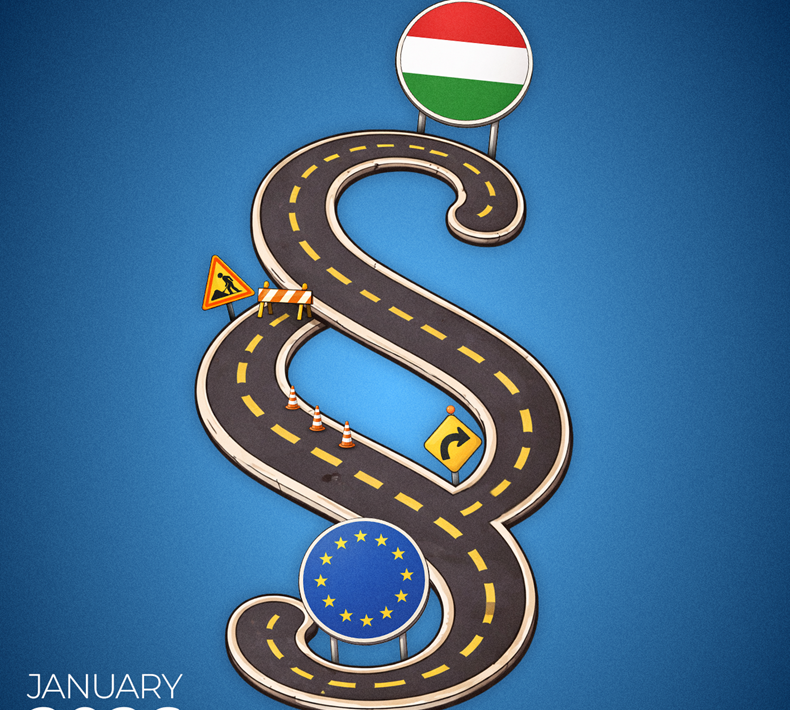


For the seventh year in a row, Amnesty International Hungary is contributing to the European Commission’s annual Rule of Law Report in coordination with other Hungarian human rights and anti-corruption CSOs in the framework of the stakeholder consultation launched by the European Commission.
Once again, Amnesty International Hungary together with the Hungarian Civil Liberties Union, the Hungarian Helsinki Committee, K-Monitor, Mertek Media Monitor, Ökotárs – Hungarian Environmental Partnership Foundation, Political Capital, and Transparency International Hungary teamed up to provide an overarching assessment of the rule of law situation in Hungary.
The compilation of the contributions of the above civil society organisations to the 2026 Rule of Law Report covers in detail all four pillars of the Rule of Law Report, namely: the justice system (its independence, the quality of justice, the efficiency of the justice system); the anti-corruption framework (institutional framework capacity to fight against corruption, prevention, repression); media pluralism and media freedom (media authorities and bodies, safeguards against government or political interference, media ownership, protection of journalists, freedom of information); and other institutional issues related to the system of checks and balances (legislative process, independent authorities, execution of judgments, framework for CSOs).
As part of the above exercise, we also assessed at the beginning of each chapter the measures taken by the Hungarian government to follow-up on the recommendations it received in last year’s Rule of Law Report, concluding that the Hungarian authorities have not implemented any of the recommendations put forth by the Commission in 2025.
The contribution covers several developments from last year that negatively affected the rule of law situation in Hungary, such as:
- the continuation of smear campaigns and political attacks against both individual judges and the judiciary in general further increased the chilling effect amongst Hungarian judges;
- despite amending justice-related laws once again in 2025, no measures were introduced to improve the transparency of case allocation systems at lower instance courts;
- Hungary’s top court aims to use domestic procedures to block the direct effect of EU law;
- no steps have been taken to adopt automatic annual adjustment of judicial salaries, while the new “financial compensation” regime threatens the independent and effective functioning of courts;
- the National Judicial Council’s right to comment on draft laws was rendered devoid of substance by practice of the Minister of Justice;
- in some politically sensitive cases, the Constitutional Court went beyond its legal authority and engaged in legality review, opening the door to arbitrary proceedings as a de facto fourth instance court;
- 17% of all government decrees were adopted as emergency decrees, many of which were adopted for purposes not related to the war in Ukraine (the cause of the state of danger);
- open disregard for certain domestic court decisions that are unfavourable to the governing parties and the non-implementation of a high number of European court judgments;
- a constitutional amendment and related statutory changes led to the banning of both the Budapest Pride and the Pécs Pride, a severe restriction of the right of peaceful assembly;
- a new exclusionary law on the “protection of local identity” authorised municipalities to adopt discriminatory decrees affecting housing to the poor and to Roma people;
- independent media and CSOs that criticise government policies and/or represent vulnerable groups continue to operate under increasing political pressure and the threat of the adoption of a bill that would allow their blacklisting and impose limitations on their funding.
The contribution of the eight civil society organisations on the state of rule of law in Hungary in 2025 is available here:
Hungarian CSO contributions to earlier Rule of Law Reports are available here: 2020, 2021, 2022, 2023, 2024, 2025.